
As temperatures continue to rise during the warmer months, finding an effective way to stay cool becomes increasingly important. But what is the best option?
Fans may not provide enough cooling, while traditional air conditioners can lead to higher electricity bills. If installing an air conditioning system isn’t practical or you’re looking for a more affordable cooling solution, an evaporative air cooler may be a great alternative.
Evaporative air coolers use less energy than traditional air conditioning systems while providing more cooling power than a standard fan. Some models can also help add moisture to dry air and improve air circulation. They are also easy to use and typically do not require professional installation.
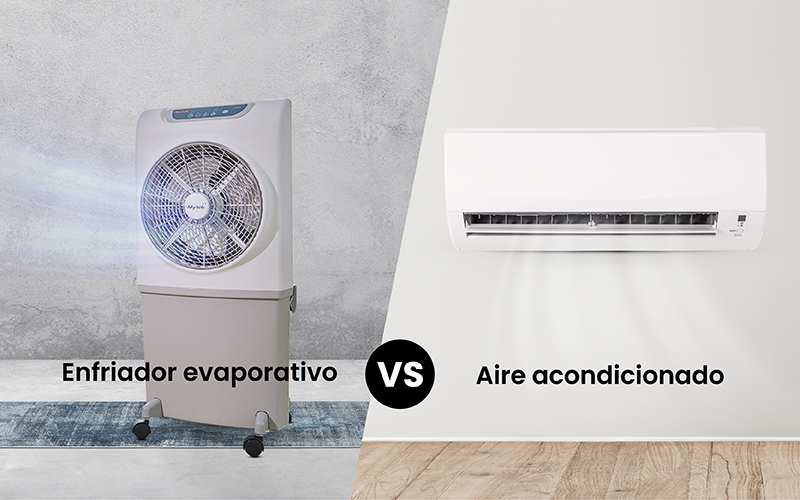
Although evaporative air coolers can look similar to portable air conditioners, the two work very differently. Each has its own advantages depending on the environment and how you plan to use it.
Here’s what you should know when comparing an evaporative air cooler vs. an air conditioner.
How They Work
Evaporative air coolers are sometimes mistaken for “mini air conditioners,” but they use completely different cooling methods.
Air conditioners remove heat from indoor air and transfer it outside using a refrigeration system. They also remove moisture from the air and allow users to maintain a specific indoor temperature.
Evaporative air coolers use the natural process of water evaporation to cool incoming warm air. Because this process adds moisture to the air, evaporative coolers generally perform best in hot, dry climates and well-ventilated or open spaces.
Unlike air conditioning, an evaporative cooler does not provide precise temperature control. Instead, it helps lower the surrounding temperature while continuously circulating fresh air.
Evaporative Air Coolers
An evaporative air cooler creates a refreshing breeze by drawing warm air into the unit and passing it through water-saturated cooling pads.
As the water naturally evaporates, heat is removed from the incoming air. A fan then pushes the cooler air back into the surrounding space.
Most evaporative air coolers consist of a fan, water tank, and cellulose cooling pads. They generally operate most effectively in areas with relative humidity below 60% and are especially useful in open or well-ventilated spaces.
Air Conditioners
Air conditioners use a refrigeration cycle to remove heat from indoor air.
Warm air is drawn into the system, where refrigerant absorbs the heat. The refrigerant then moves through components such as the compressor, condenser, evaporator, and expansion valve, transferring the heat outdoors.
This process allows an air conditioner to significantly reduce indoor temperatures and maintain a specific temperature setting.
Portable Air Conditioners
Window units and split or mini-split systems are common air conditioning options, but permanent installation isn’t practical for every space.
Portable air conditioners provide more flexibility because the unit itself can be moved. However, they still need to vent hot air outside, typically through an exhaust hose connected to a window.
Energy Consumption
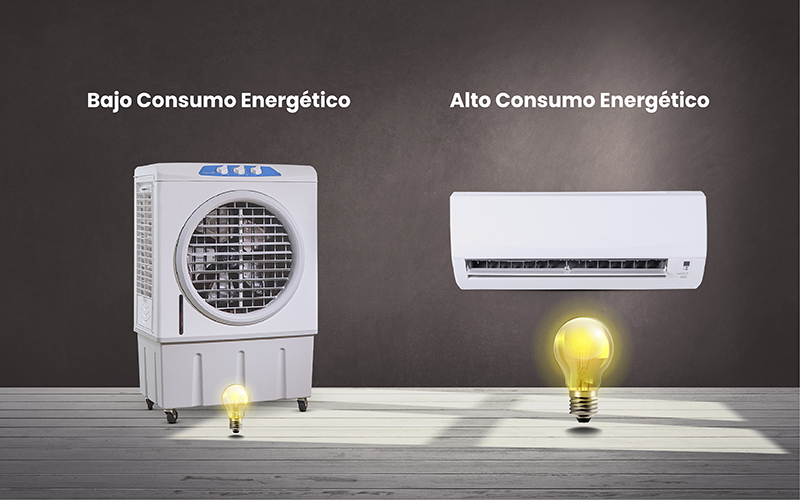
One of the biggest differences between evaporative air coolers and air conditioners is energy consumption.
Evaporative coolers generally use significantly less electricity because their primary components are a water pump and fan. Traditional air conditioners require additional components, including a compressor and refrigeration system, which require considerably more power to operate.
For example, the Mytek 3399 Portable Evaporative Air Cooler features a 60-liter water tank and operates at 210 watts. At that power level, approximately 4.8 hours of continuous operation uses 1 kilowatt-hour (kWh) of electricity.
By comparison, the Mytek 3902 1-ton mini-split air conditioner operates at 1,185 watts with a cooling capacity of 12,000 BTU. At that power level, it uses approximately 1 kWh in about 0.8 hours of continuous operation.
Understanding kWh
A watt (W) measures electrical power, while a kilowatt (kW) equals 1,000 watts.
A kilowatt-hour (kWh) measures the amount of electricity used over time.
1,000 W = 1 kW
Running a 1,000-watt appliance for one hour uses approximately 1 kWh of electricity.
Your actual electricity cost depends on your local utility rate. To estimate operating costs, multiply the appliance’s energy consumption in kWh by your electricity rate per kWh.
Energy Comparison
| Feature | Mytek 3399 Evaporative Air Cooler | Mytek 3902 Air Conditioner |
|---|---|---|
| Capacity | 60 L Water Tank | 1 Ton / 12,000 BTU |
| Voltage | 127V | 220V |
| Power | 210W | 1,185W |
| Energy Consumption* | 75.6 kWh | 426.6 kWh |
| Cooling Area | 93 m² | 18–26 m² |
*Based on 12 hours of use per day for 30 days.
Installation and Everyday Use
Evaporative air coolers are generally simple to set up and operate. Most portable models arrive ready to use: fill the water tank, plug the unit in, and turn it on.
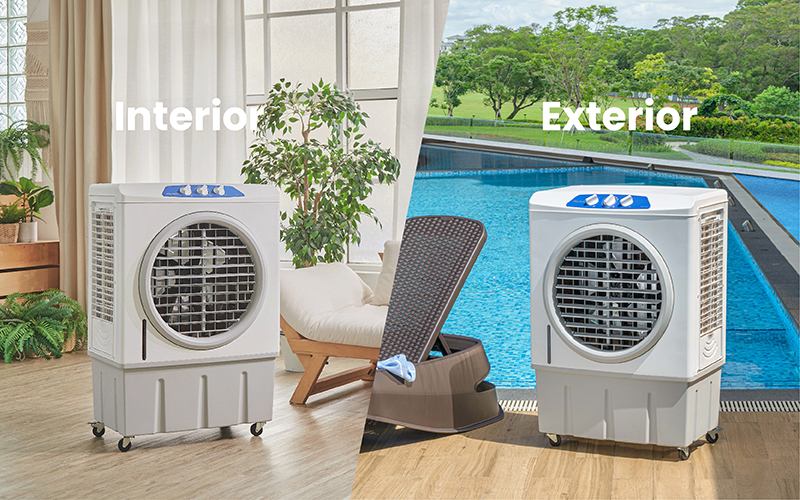
Portable models with caster wheels can easily be moved between different areas, making them useful for indoor and outdoor applications where ventilation is available.
Maintenance is also relatively straightforward. The water tank and cooling pads should be cleaned periodically to help maintain performance.
Traditional air conditioning systems usually require more installation. Window and split systems are installed in fixed locations and may require professional installation or modifications to the building.
Even portable air conditioners require access to a window or another suitable location for exhausting hot air outdoors.
Cooling Efficiency
Air conditioners are designed to quickly lower and control the temperature inside enclosed spaces.
Evaporative air coolers work differently. Warm air passes through water-saturated cooling pads, where evaporation removes heat from the air. A powerful fan then distributes the cooled air throughout the surrounding area.
Cooling performance depends heavily on temperature and humidity. Evaporative cooling is generally most effective in hot, dry environments, while performance decreases as humidity increases.
For the best results, evaporative coolers should be used with adequate ventilation and a consistent supply of fresh air.
Environmental Considerations
Energy efficiency has become an increasingly important consideration when choosing cooling equipment.
Evaporative air coolers use water and the natural process of evaporation to cool the air. Because they do not rely on a compressor-driven refrigeration cycle, they typically require considerably less electricity than traditional air conditioning systems.
Air conditioners rely on refrigerants and compressors to transfer heat. Their overall environmental impact depends on factors such as electricity consumption, system efficiency, refrigerant type, maintenance, and how the electricity powering the unit is generated.
For businesses and homeowners in suitable climates, evaporative cooling can provide a lower-energy option for improving comfort in open and well-ventilated spaces.
Price
Cost is another important consideration when comparing cooling systems.
Evaporative air coolers generally have a lower upfront cost than many traditional air conditioning systems. They also typically do not require professional installation, which can further reduce the initial investment.
Air conditioner pricing varies considerably depending on cooling capacity, system type, efficiency, and installation requirements. Window units, portable air conditioners, and mini-split systems all have different purchase and installation costs.
Mini-split systems can require additional materials and professional installation, adding to the total cost of the system.
Portable air conditioners eliminate some installation requirements but still require proper exhaust ventilation.
Evaporative Air Cooler vs. Air Conditioner: Which Is Right for You?
Evaporative air coolers and air conditioners both provide cooling, but they are designed for different environments and applications.
An evaporative air cooler may be a good choice when you want:
- Lower energy consumption
- Simple setup
- Portable cooling
- Fresh air circulation
- Cooling for dry climates
- Cooling for patios, workshops, garages, restaurants, event spaces, and other open or well-ventilated areas
An air conditioner may be more appropriate when you need:
- Precise temperature control
- Cooling for enclosed rooms
- Strong cooling in humid climates
- Whole-room or whole-building temperature management
The best option ultimately depends on your climate, space, budget, and cooling needs.
Understanding how each system works can help you choose the cooling solution that makes the most sense for your home or business.
You May Also Be Interested In
Featured Mytek Evaporative Air Coolers
What Is an Evaporative Air Cooler?